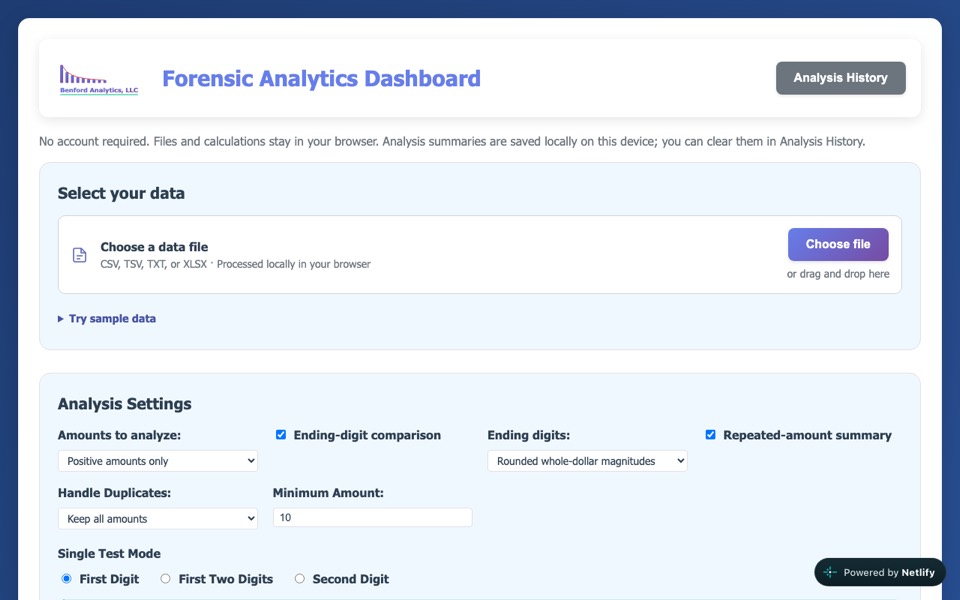
Screenshot of Benford Analysis Pro

Benford Analysis Pro

What it’s for
A first look at whether a numeric dataset follows the digit patterns Benford's Law predicts.
How it works
Compares first-digit, first-two-digit, second-digit, and last-two-digit frequencies to expected patterns, and checks for duplicates, using chi-square, Z-statistic, and Mean Absolute Deviation (MAD) measures.
What you get
Charts, conformity ratings, a data-suitability check, and suggested review steps. It does not rate fraud risk.
Limitations
Requires data suited to Benford analysis: large sets of naturally occurring amounts spanning several orders of magnitude.
Open Benford Analysis Pro Examples and limitations
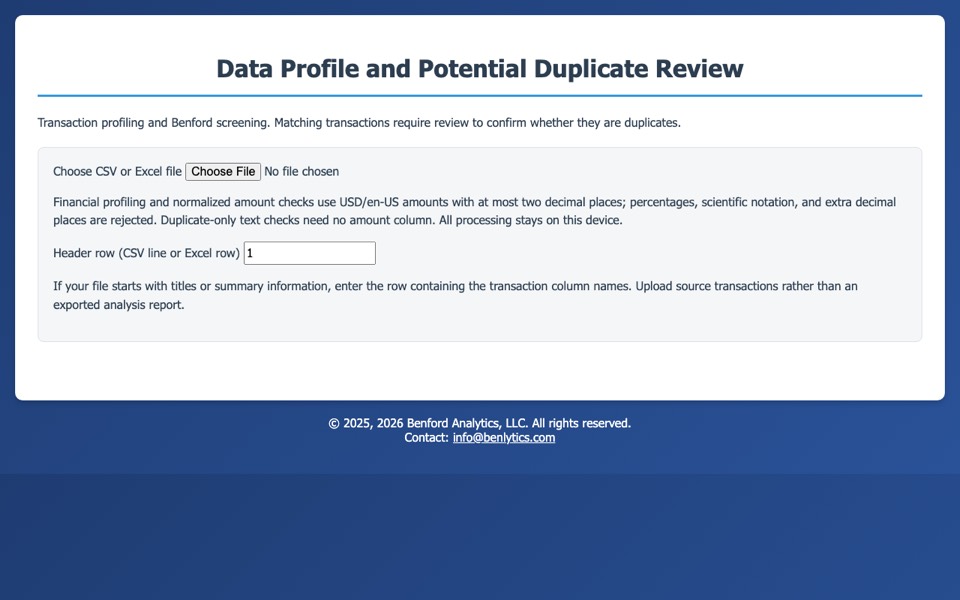
Screenshot of Data Profile & Duplicate Review

Data Profile & Duplicate Review

What it’s for
Understanding a dataset before testing it, and finding potential duplicates.
How it works
Summarizes record counts, missing values, zeros, signs, ranges, and repeated amounts or records.
What you get
A profile of the data's structure and quality, plus a list of potential duplicates for review.
Limitations
Potential duplicates may be legitimate. Each one requires review against source documents.
Open Data Profile & Duplicate Review Examples and limitations
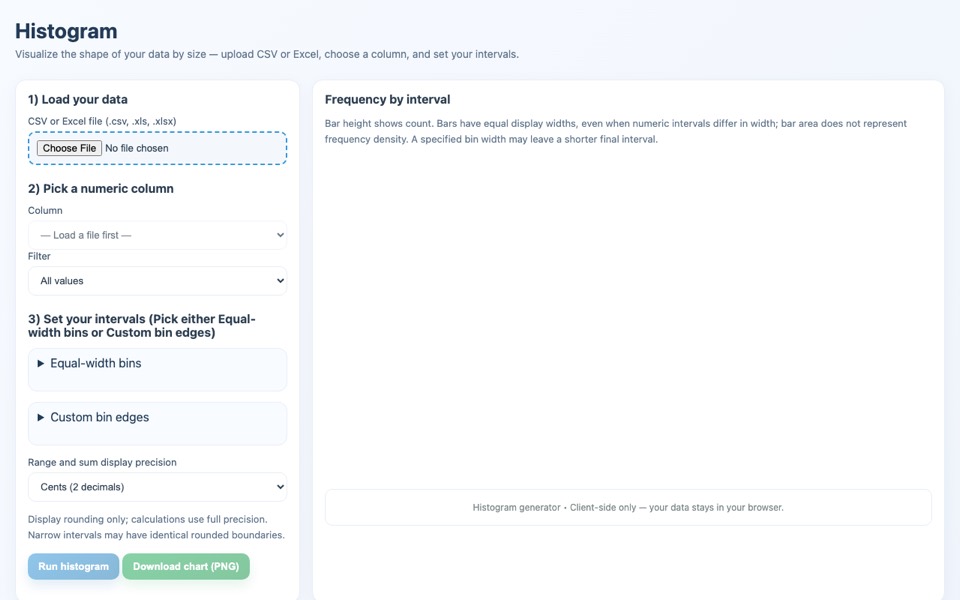
Screenshot of Histogram Analysis

Histogram Analysis

What it’s for
Seeing the shape of a dataset's distribution.
How it works
Groups values into ranges and charts their frequency to reveal clustering, round-number heaping, and artificial caps.
What you get
A visual distribution and summary statistics.
Limitations
Visual patterns are indicators that call for judgment, not conclusions.
Open Histogram Analysis Examples and limitations
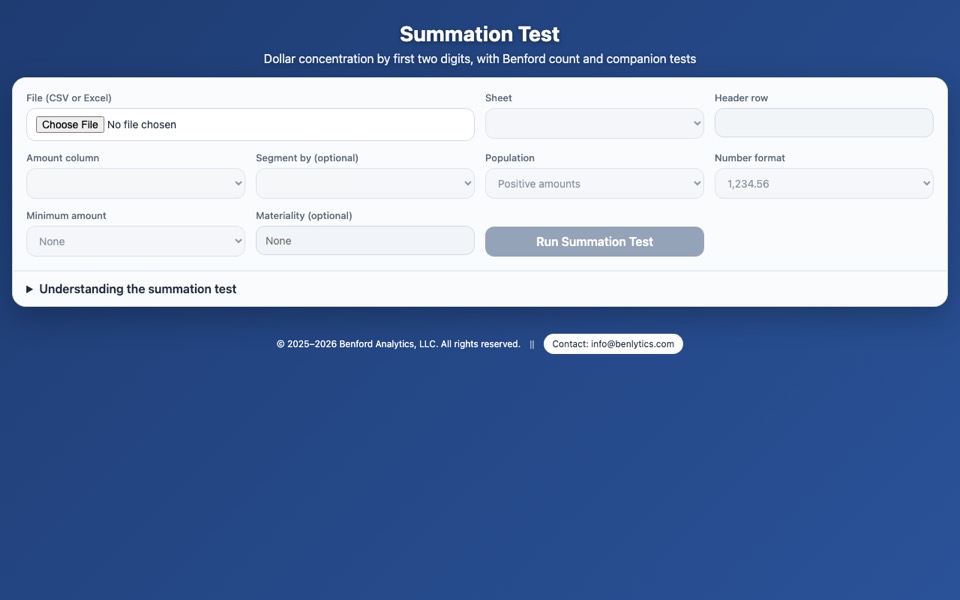
Screenshot of Summation Test

Summation Test

What it’s for
Finding unusually large amounts, or groups of amounts, that dominate a dataset.
How it works
Totals amounts by leading digits and compares each group's share to the even pattern expected under Benford's Law.
What you get
A chart of each digit group's share, highlighting those that stand out.
Limitations
A few legitimate large transactions can cause a spike.
Open Summation Test Examples and limitations
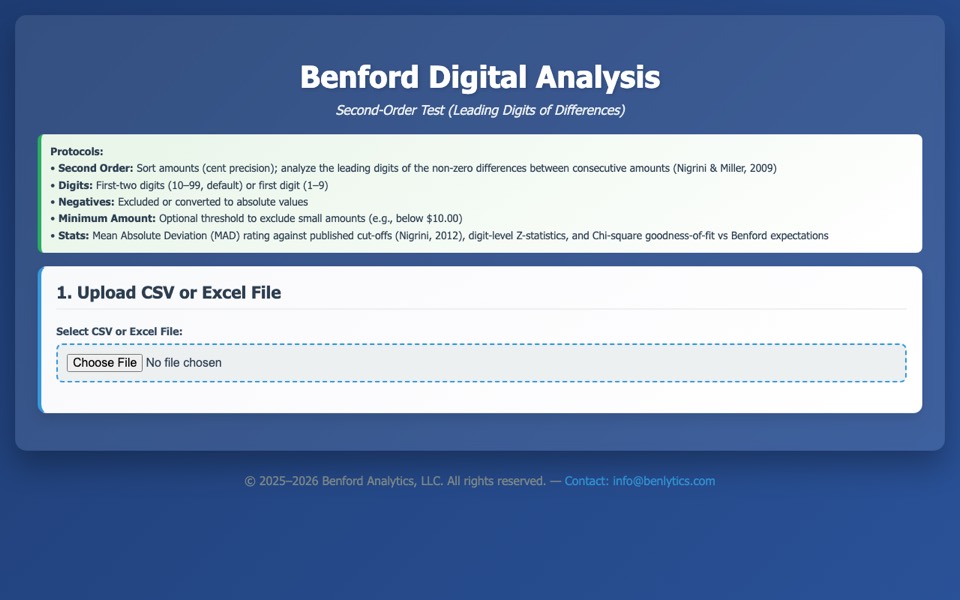
Screenshot of Second-Order Test

Second-Order Test

What it’s for
Detecting signs of data that was rounded, smoothed, or generated rather than recorded.
How it works
Sorts the values and tests the digit patterns of the differences between consecutive values.
What you get
A digit-frequency comparison that can reveal processing problems or invented numbers.
Limitations
Results can be affected by heavy rounding or repeated values in legitimate data.
Open Second-Order Test Examples and limitations
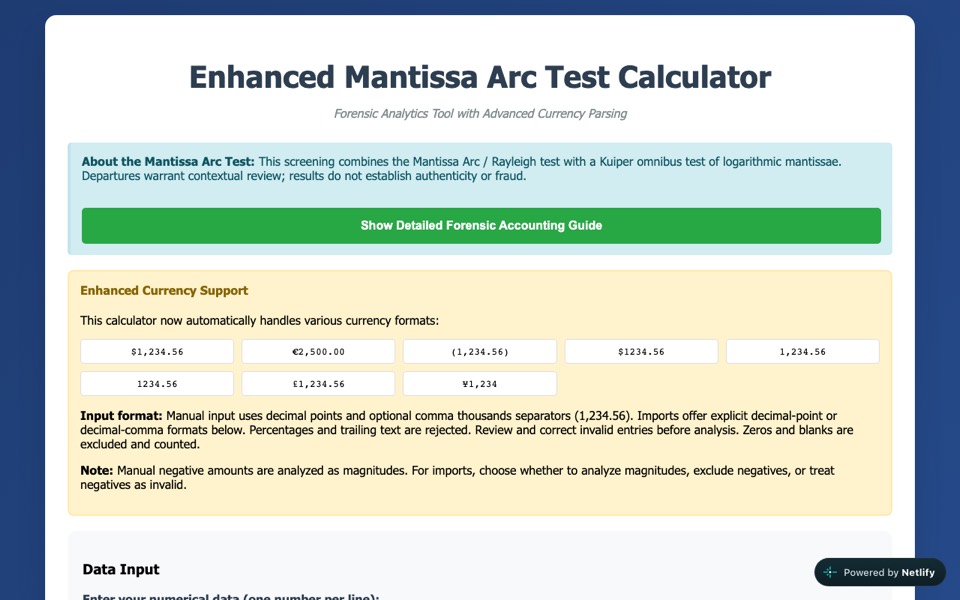
Screenshot of Mantissa Arc Test

Mantissa Arc Test

What it’s for
An overall check of how closely a dataset conforms to Benford's Law.
How it works
Maps the fractional parts of the values' logarithms ("mantissas") around a circle and measures how evenly they are spread, with a second test (Kuiper) of the full distribution.
What you get
A conformity statistic and a visual plot.
Limitations
A single overall measure; use alongside digit-level tests.
Open Mantissa Arc Test Examples and limitations
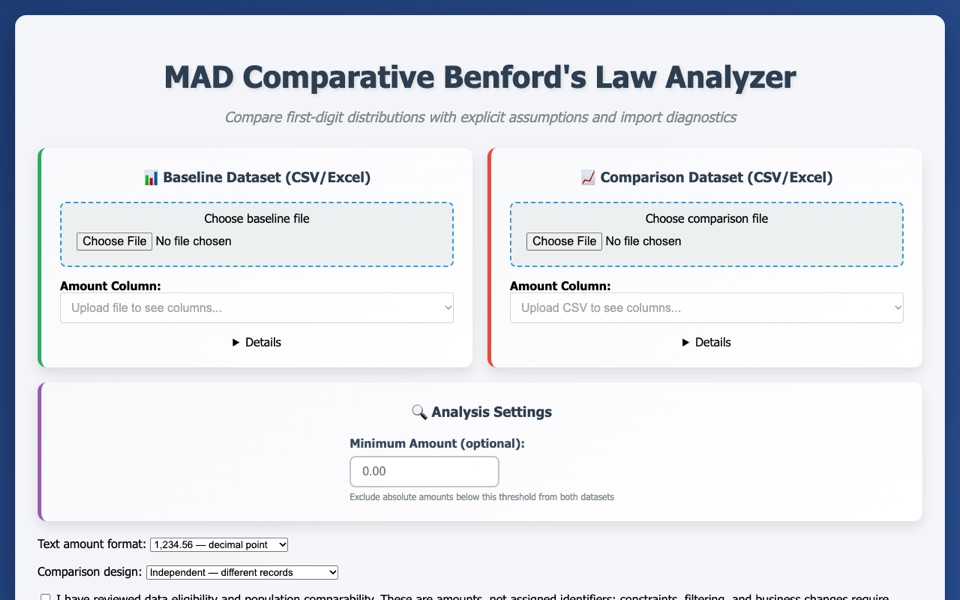
Screenshot of MAD Comparative Analysis

MAD Comparative Analysis

What it’s for
Comparing how closely two datasets, such as two periods or two locations, follow Benford's Law.
How it works
Calculates each dataset's Mean Absolute Deviation (MAD) from the expected first-digit frequencies, rates conformity, and tests whether the two datasets' digit patterns differ.
What you get
MAD and a conformity rating for each dataset, the change between them, and the result of a between-dataset test.
Limitations
Conformity ratings are guides, not pass/fail determinations.
Open MAD Comparative Analysis Examples and limitations
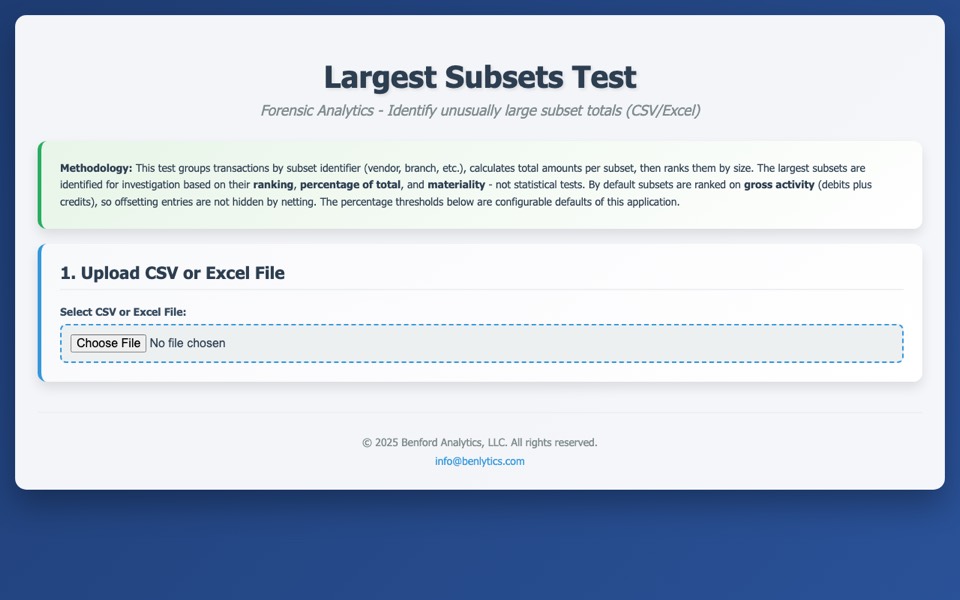
Screenshot of Largest Subsets Test

Largest Subsets Test

What it’s for
Deciding where to focus within a large population, for example by vendor, branch, or cost center.
How it works
Totals amounts by group, ranks the groups by size and share of the total, and can compare them with a prior period to show the largest changes.
What you get
A ranked list of groups worth a closer look.
Limitations
Large groups are often large for legitimate business reasons.
Open Largest Subsets Test Examples and limitations

Need a test these applications don’t cover?

Benford Analytics builds custom analytics tools for specific data and procedures.

Discuss a project

Use of these applications: The applications are provided as-is for analytical purposes. Results identify items for further review and are not audit evidence or conclusions about fraud or error.