Benford Analysis Pro: free Benford's Law digit tests
A first look at whether a numeric dataset follows the digit patterns Benford's Law predicts.
What it detects
Departures from the leading-digit pattern that Benford's Law predicts. Departures can point to invented amounts, amounts kept just under an approval limit, duplicated payments, or processing errors.
How it works: Compares first-digit, first-two-digit, second-digit, and last-two-digit frequencies to expected patterns, and checks for duplicates, using chi-square, Z-statistic, and Mean Absolute Deviation (MAD) measures.
What you get: Charts, conformity ratings, a data-suitability check, and suggested review steps. It does not rate fraud risk.
When to use it
- As a first test on a large set of naturally occurring amounts, such as invoices, disbursements, expense claims, or sales.
- To decide which parts of a population deserve a closer look.
- Alongside other tests, as one piece of evidence rather than the only one.
When not to use it
- Assigned or sequential numbers: check numbers, invoice numbers, ZIP codes, IDs.
- Amounts set by a price list or fee schedule, or limited by a minimum or maximum.
- Small datasets (generally fewer than several hundred records), or amounts that don’t span several orders of magnitude.
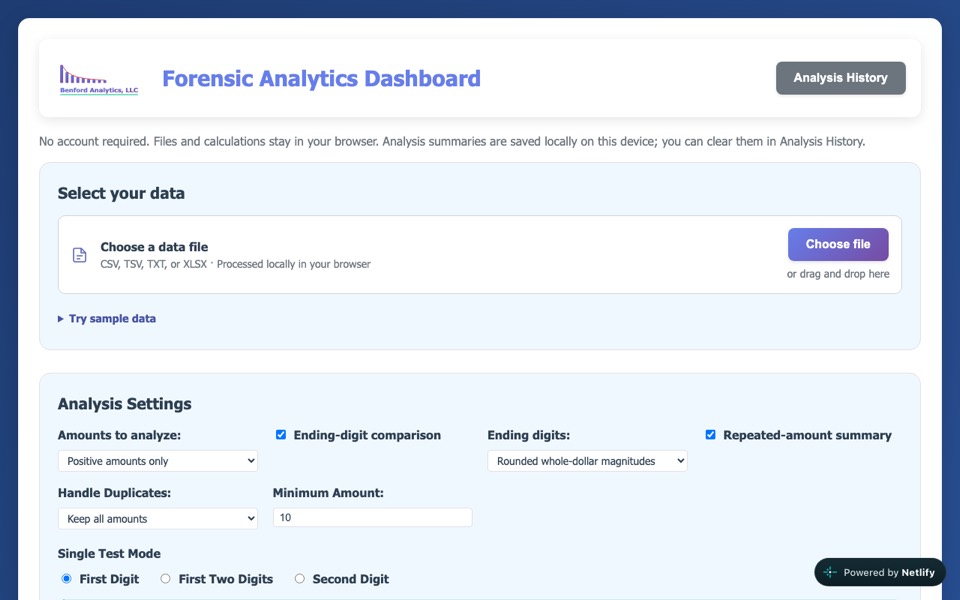
Free, with no account. Your data is processed entirely in your web browser and never leaves your computer.
Example
Synthetic example: 2,000 vendor invoices, where invoices of $6,000 or more need a second approval. Most first digits are close to Benford’s Law, but first digit 5 stands out because several amounts sit just under the $6,000 limit.
| First digit | Expected % | Observed % |
|---|---|---|
| 1 | 30.1% | 29.2% |
| 4 | 9.7% | 9.4% |
| 5 | 7.9% | 11.6% |
| 6 | 6.7% | 5.1% |
Next step: list the invoices from $5,000 to $5,999 and review them against approvals and source documents.
The example uses made-up data for illustration. Results identify items for follow-up; they are not audit evidence or conclusions about fraud or error.
Launch Benford Analysis ProNeed more than a free tool?
Benford Analytics can run these tests on your data, interpret the results, and build custom procedures for your situation.
Fraud and financial analytics →The digit tests and conformity measures follow the approach described in Mark J. Nigrini, Benford's Law: Applications for Forensic Accounting, Auditing, and Fraud Detection (Wiley, 2012). Benford Analytics is not affiliated with or endorsed by Dr. Nigrini.