Data Profile & Duplicate Review: know your data before you test it
Understanding a dataset before testing it, and finding potential duplicates.
What it detects
Problems that make later tests unreliable: missing values, zeros, negative amounts, unexpected ranges, and repeated amounts or records that may be duplicates.
How it works: Summarizes record counts, missing values, zeros, signs, ranges, and repeated amounts or records.
What you get: A profile of the data's structure and quality, plus a list of potential duplicates for review.
When to use it
- Before any Benford’s Law test, to confirm the file is complete and suitable.
- To find potential duplicate payments or records for review.
- To document the population you tested.
When not to use it
- As proof that a record is a duplicate. Repeated amounts are often legitimate (recurring rent, standard fees), so each one needs review against source documents.
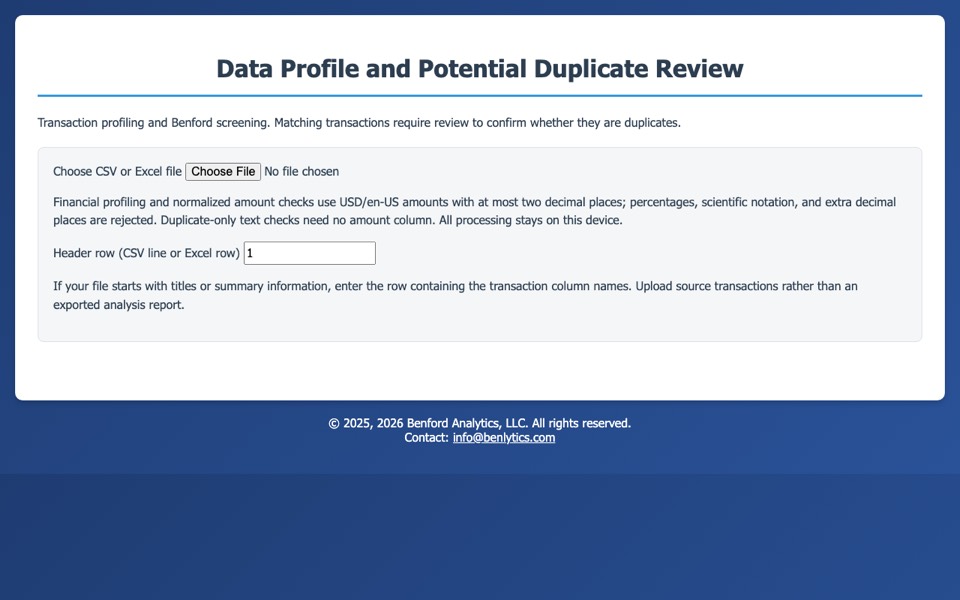
Free, with no account. Your data is processed entirely in your web browser and never leaves your computer.
Example
Synthetic example: a file of 1,200 payments has 14 blank amounts, 37 zero amounts, and 6 negative amounts, and shows 9 pairs of payments with the same vendor, date, and amount. The blanks and zeros are set aside before digit testing, and the 9 pairs go on a list for review.
The example uses made-up data for illustration. Results identify items for follow-up; they are not audit evidence or conclusions about fraud or error.
Launch Data Profile & Duplicate ReviewNeed more than a free tool?
Benford Analytics can run these tests on your data, interpret the results, and build custom procedures for your situation.
Fraud and financial analytics →