Largest Subsets Test: decide where to focus
Deciding where to focus within a large population, for example by vendor, branch, or cost center.
What it detects
Groups, such as vendors, employees, branches, or cost centers, that account for a disproportionate share of the total, and, with a prior-period file, the groups that grew the most. It ranks by size and share; it does not apply statistical tests.
How it works: Totals amounts by group, ranks the groups by size and share of the total, and can compare them with a prior period to show the largest changes.
What you get: A ranked list of groups worth a closer look.
When to use it
- When a population is too large to review evenly, and you need to choose where to start.
- Before running digit tests on individual groups.
When not to use it
- As a finding on its own. Large groups are often large for legitimate business reasons, such as a main supplier.
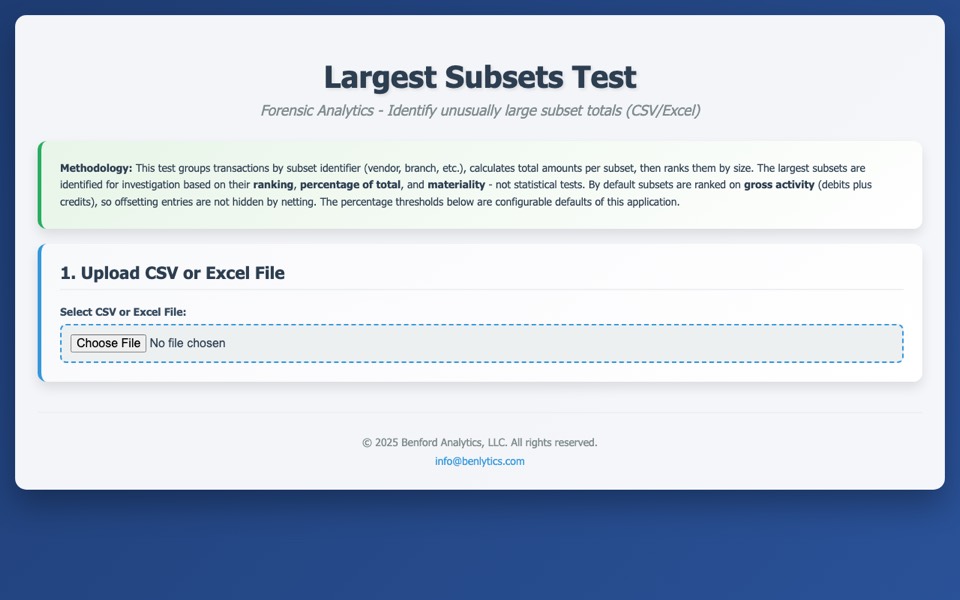
Free, with no account. Your data is processed entirely in your web browser and never leaves your computer.
Example
Synthetic example: 8,500 payments to 640 vendors are grouped by vendor and ranked. One vendor accounts for 3% of the payments but 22% of the dollars, far more than any other vendor of its kind.
Next step: review that vendor’s contract, pricing, and approvals.
The example uses made-up data for illustration. Results identify items for follow-up; they are not audit evidence or conclusions about fraud or error.
Launch Largest Subsets TestNeed more than a free tool?
Benford Analytics can run these tests on your data, interpret the results, and build custom procedures for your situation.
Fraud and financial analytics →The largest subsets test is described in Mark J. Nigrini, Benford's Law: Applications for Forensic Accounting, Auditing, and Fraud Detection (Wiley, 2012). Benford Analytics is not affiliated with or endorsed by Dr. Nigrini.