Second-Order Test: check how your data was produced
Detecting signs of data that was rounded, smoothed, or generated rather than recorded.
What it detects
Signs that data was rounded, smoothed, generated by a formula, or damaged in processing, rather than recorded as it occurred.
How it works: Sorts the values and tests the digit patterns of the differences between consecutive values.
What you get: A digit-frequency comparison that can reveal processing problems or invented numbers.
When to use it
- When you need to judge whether data was recorded naturally, for example before relying on an extract from another system.
- On data that is not suitable for first-digit testing, because the test looks at differences between values rather than the values themselves.
When not to use it
- On data with heavy legitimate rounding or many repeated values, such as prices from a price list. These create patterns that are expected, not suspicious.
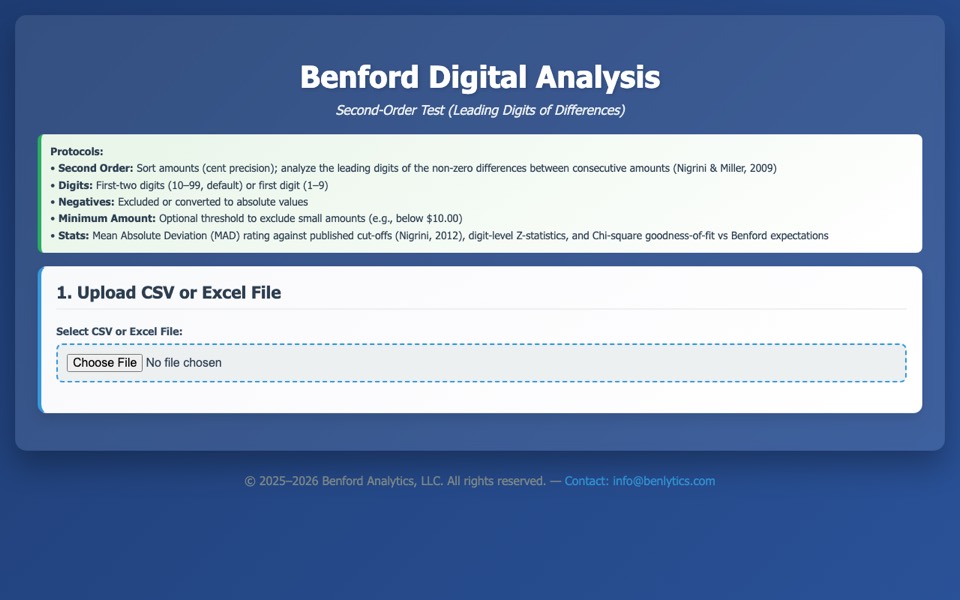
Free, with no account. Your data is processed entirely in your web browser and never leaves your computer.
Example
Synthetic example: 3,000 amounts are sorted from smallest to largest, and the differences between neighboring amounts are tested. Most differences follow the expected pattern, but differences beginning with 10, 20, 30, and so on appear far too often.
The cause: one batch of amounts had been rounded to the nearest $10 when it was keyed in.
The example uses made-up data for illustration. Results identify items for follow-up; they are not audit evidence or conclusions about fraud or error.
Launch Second-Order TestNeed more than a free tool?
Benford Analytics can run these tests on your data, interpret the results, and build custom procedures for your situation.
Fraud and financial analytics →The second-order test was introduced by Mark J. Nigrini and Steven J. Miller and is described in Mark J. Nigrini, Benford's Law: Applications for Forensic Accounting, Auditing, and Fraud Detection (Wiley, 2012). Benford Analytics is not affiliated with or endorsed by Dr. Nigrini.